

(And No One Talks About This Until Rankings Drop)
Let me guess.
Your website started clean.
A few pages.
Clear navigation.
Everything made sense.
Then content happened.
Blog posts.
Landing pages.
Feature pages.
SEO experiments.
“Let’s just add one more page…”
Fast forward—and now your site feels like a maze even you don’t fully understand.
That’s not growth.
That’s structural debt.
And here’s the uncomfortable truth most SEO blogs won’t say out loud:
“You can’t scale traffic on a broken website architecture.“
This Is Where Most Websites Go Wrong
Most people obsess over keywords, backlinks, and content volume.
Very few stop to ask:
- Does my site still make sense as a system?
- Do search engines understand what matters most?
- Are my best pages buried under clutter?
This is where website architecture optimization quietly decides winners and losers.
Search engines don’t just rank pages.
They evaluate structure, hierarchy, and clarity.
When structure breaks:
- Important pages lose authority
- Crawl budget gets wasted
- UX drops (even if design looks fine)
- Rankings flatten or decay
And the worst part?
You don’t see the problem by clicking around your site.
Why Manual Site Audits Stop Working at Scale
You can try to:
- Open your sitemap
- Scroll through URLs
- Use spreadsheets
- Run SEO tools that dump 500-row tables
But let’s be honest…
That doesn’t show you how your site actually behaves as a system.
What you need isn’t more data.
You need perspective.
A way to see:
- What to keep
- What to merge
- What to remove
- What to build next
Without guessing.
The Smarter Way: Visual Website Architecture Optimization
This is where things get interesting.
Instead of auditing pages one by one, imagine:
- Your entire site crawled automatically
- Every page mapped visually
- Structure, depth, and hierarchy revealed at a glance
Not as a boring list.
But as an interactive visual map.
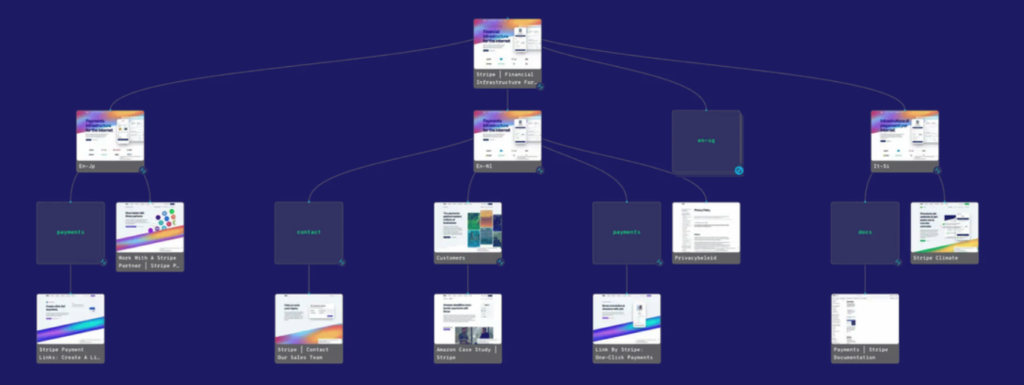
Suddenly, patterns jump out:
- Pages that should be important—but aren’t
- Sections bloated beyond reason
- Orphaned content with no clear purpose
- SEO opportunities hiding in plain sight
This is website architecture optimization the way humans actually think.
What AI Changes About Site Structure Analysis
Here’s the shift most people miss.
AI doesn’t just map your site.
It interprets it.
That means:
- Detecting weak IA and UX signals
- Identifying hierarchy breakdowns
- Highlighting under-performing or redundant pages
- Revealing missed SEO coverage automatically
Instead of asking “What’s wrong?”
You’re shown where and why.
And better yet—you get actionable recommendations, not theory.
This Is Where SEO, UX, and Strategy Finally Align
Good website architecture optimization does three things at once:
1. Improves SEO Without Chasing Keywords
Clear hierarchy tells search engines:
- What your core topics are
- Which pages deserve authority
- How content connects semantically
2. Fixes UX Without Redesigning Everything
Visitors:
- Find pages faster
- Understand your offer better
- Move naturally through your site
3. Makes Growth Decisions Obvious
You instantly know:
- What content to expand
- What pages to consolidate
- Where gaps exist versus competitors
- What not to build next
That alone saves weeks of guessing.
Why Agencies and SaaS Teams Quietly Rely on This
If you manage:
- Large websites
- Client sites
- Growing SaaS platforms
- Content-heavy blogs
You know the pain:
- Endless audits
- Conflicting opinions
- SEO vs UX arguments
- Stakeholders asking “Why?”
Visual, AI-driven architecture analysis ends that debate.
Because when everyone can see the structure, alignment becomes easy.
And when reports export cleanly (PDF, CSV, Markdown), collaboration stops being painful.
Competitive Advantage Most Sites Ignore
Here’s the sneaky part.
While others:
- Publish more content
- Add more pages
- Chase more keywords
You:
- Strengthen structure
- Reduce bloat
- Close topic gaps intelligently
- Build only what matters
That’s how you:
- Scale faster
- Recover stalled rankings
- Future-proof SEO changes
Not by working harder—but by architecting smarter.
Bottom Line
If your site feels “big” but not “clear”…
If SEO progress feels capped despite good content…
If growth feels messy instead of strategic…
Then the issue probably isn’t your keywords.
It’s your website architecture optimization.
Fix the structure—and everything else starts working better.
Sometimes, the smartest growth move
isn’t adding more pages…
It’s finally understanding the ones you already have.